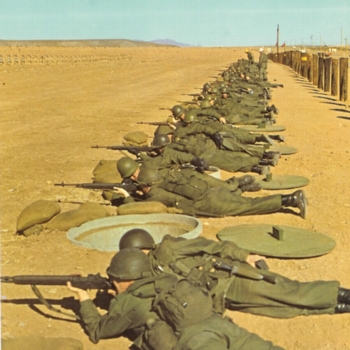
M-14 rifle training in the desert, Ft. Bliss, TX. The green wooden lids prevented snakes, sand and tumbleweeds from getting into the foxholes when they weren’t in use. In this photo, we were learning to fire from the prone position.

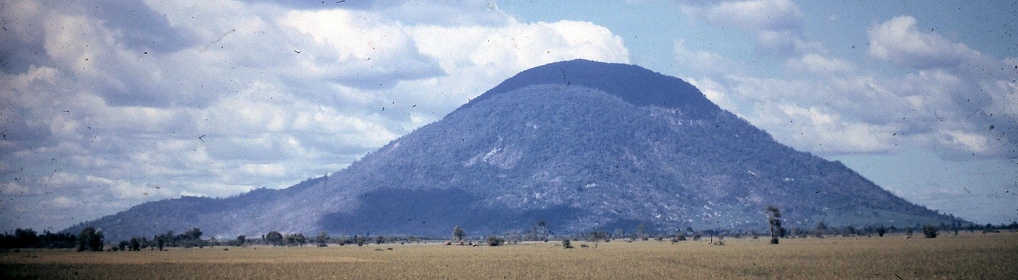

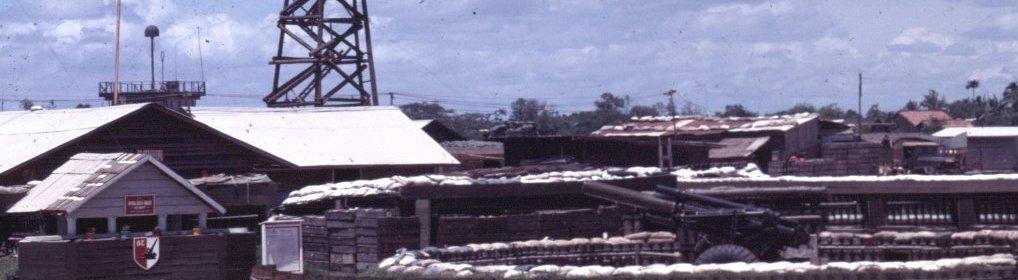
M-14 rifle training in the desert, Ft. Bliss, TX. The green wooden lids prevented snakes, sand and tumbleweeds from getting into the foxholes when they weren’t in use. In this photo, we were learning to fire from the prone position.
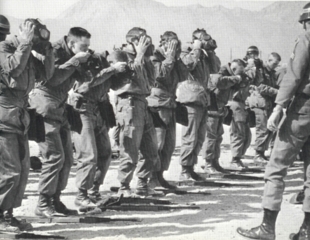
CBR (Chemical, Biological, Radiological) Training with Protective Mask. During this portion of training we were exposed to CS gas (military version of tear gas), chlorine and other nasty stuff. Our drill sergeants made us break the seal on our masks so we could get a whiff of the gas. This made a believer out of you real quick!
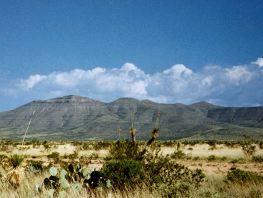
I found nothing exciting about the terrain that surrounded our base, but at least I can say the weather was unique. It isn’t often that one gets the opportunity to watch it rain a half mile away while a blistering hot wind blows sand and dust into your face. And then there were the red ants…
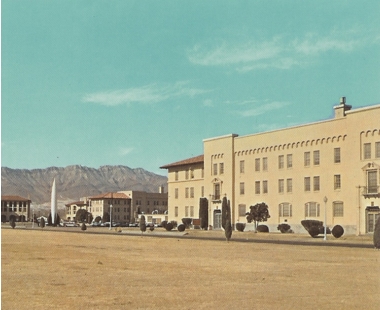
The infamous Reception Station at Ft. Bliss, TX where two drill sergeants lined us up out front and gave us our first royal ass chewing. I’ve always wondered if drill sergeants came by this “talent” naturally or if it was taught to them in drill sergeant school.
Accidentally firing on your own troops or allies occurs in almost every war. It can involve any form of weapon; artillery, bombs, small arms fire, air strikes, etc. I’m aware that some “friendly fire” incidents were actually intentional, such as fraggings, but I’m sure the vast majority were simply mistakes; mistakes made in the heat of battle or maybe even a routine mission.
Having twice been on the receiving end of such incidents during my tour in Vietnam, I can assure you that I view the term “friendly fire” as a misnomer. A more correct term might be something like “errant fire from friendlies” (EFFF for short) or something along that line. In any case, we were fortunate that no one got hurt or killed. The first incident occurred at Ben Cau in September of 1969. We were at an ARVN infantry/basic training camp. Unlike most of the camps we stayed at, this one had many permanent buildings. Most had sandbags lining the exterior walls, which might’ve prevented injuries when the errant howitzer rounds impacted inside the camp. We never did learn where they came from. Thankfully, it was only one volley and not a continuous barrage.
The other incident occurred under rather strange circumstances. We were based at a small ARVN infantry camp near Loc Giang. About 1/2 mile to the east was FSB Jackson, an American camp. One day the howitzer battery at Jackson conducted a fire mission during a very heavy rain storm. I’m not real sure of the cause, but some of the howitzer projectiles detonated prematurely right over our camp. The heavy rain might have disturbed the proximity fuses in some way, I don’t know. In any case, it sure sent those of us in our tent scrambling for cover!
A 1Lt. Advisor at our camp quickly made a land-line call to the commander at Jackson and explained the problem. I think two more rounds exploded over our camp before they believed the message. It was no surprise that tempers ran a little hot for a while. As far as I know, my radar team was not involved in any out-going friendly fire incidents (thank God). During my year with the team, we detected hundreds of targets and many were fired upon by the artillery people. Thanks to good work by everyone involved in the chain; TOC, the gun batteries, FO’s, the infantry in the field and our own radar team, we managed to avoid any unfortunate incidents.
St. El-mo’s fire (el’mohz) n.
 I feel like I’m looking at the world through the wrong end of a telescope. Everything appears distant and as if it’s in a tunnel. My best friend is talking to me but I do not recognize his voice. For some reason I find that I’m trying desperately to grasp onto something familiar; a face, a name, anything! My confused, foggy brain keeps trying to sort things out. A name. I’m thinking of a name. It’s my wife’s name! I hold on to that thought as if my life depended on it. What the heck is going on?
The day really hadn’t started out all that badly, although I do hate moving our radar system, something we must do every few weeks. The sarcastic comments from my teammates confirm that I’m not alone in those feelings. What made this move different, however, was the newly issued tower; all 84 feet of it.

We received orders to move the night before, which was quite typical. Everything was going smoothly when we broke camp early the next morning, until we got down to the last 4 sections, or 24 feet worth. The tower was first assembled only to the 60 foot level and there were 3 sets of guy-wires to support it. Later, 4 additional sections were delivered and the tower height was increased to 84 feet. To evenly spread out the wires, we moved each wire set up a section or two. Our mistake was dropping the lower (last) set of guy wires rather than re-attaching them to the second or third level. When I swung the fifth section over the side, over we went. In short, we screwed up.
I don’t remember anything after the very first hint we were tipping. As luck would have it, we crashed right in the middle of the tower sections we had just removed. My buddy said I actually broke a piece of the aluminum tubing on one of the sections with my head. I guess I was fortunate the tubing was thin-wall. The only other guy on the tower messed up his knee pretty bad.
By the time my senses started returning I found myself sitting in the ¾ ton truck as my buddies took us back to base camp for a medical checkup. As luck would have it, we were on a barge, crossing the Song Vam Co Dong River when I realized I was in this sorry place called Vietnam. Happy days.
The doc checked us over and decided to keep us overnight for observation, most likely because of the bump I took on my head. I was in quite a bit of pain and the idea of having the night off sounded terrific, not to mention a couple of hot meals, a real shower and a nice bed! I took the pain medication the doc gave me and turned-in early, anticipating a peaceful night’s sleep. Unfortunately, a monsoon had different ideas. Heavy rain on a tin roof makes for a bunch of noise, not to mention the thunder and lightning. Nuts!
As we’re laying there, wondering if the storm will ever pass, a strange phenomenon appeared. At first, neither of us knew for sure what it was. As the turquoise halos moved slowly around the roof-rafters my buddy shrieked, “don’t touch anything!” We both felt kind of silly when we figured out what it was and that it was harmless. It’s the only time in my life I’ve seen St. Elmo’s Fire. A fitting end to a rather strange day.
Early the next morning, one of our teammates arrived and gave us a lift to our new camp site. We received a bunch of ribbing for avoiding setting up the radar system. By now, my injuries, although not serious, are becoming very uncomfortable. I’m convinced I have a cracked rib or broken rib or two. A few days later I returned to the base camp in Tay Ninh for some X-rays. They reveal nothing. In retrospect, I regret that trip. While I was waiting for the X-ray results, a Dustoff arrived with casualties. What made this Dustoff unique was the fact the casualties were children. It appeared they had tripped a booby-trap or ended up near some type of explosion. One of them was certainly going to lose a leg, if not his life. It took me weeks to shake the affects of that terrible image. And Lord knows, I’ll never forget it.
The cuts on my back did eventually become infected with ring-worm or some such thing and it took a couple of months to get rid of the symptoms. Nothing to complain about, really. Things could’ve turned out far worse.
While based at the ARVN boot camp near Ben Soi, we had a brief encounter with the Chieu Hoi program when a Viet Cong soldier “came-across” to our side, so-to-speak. I believe these “defectors” were called Hoi Chanhs (returnee), once they promised to stay and help the South Vietnamese.
I remember seeing leaflets falling from the sky on a few different occasions in an effort to get VC and NVA to defect to our side. Possession of a leaflet was supposed to guarantee safe passage for the defector. The VC soldier that defected to our camp was actually a spy of sorts. He had no intention of staying. He just wanted to gather information about our installation and then boogie back to his comrades. Unfortunately for him, he failed to take into account (with any accuracy, anyway) the mine-field that lay between himself and his buddies. He didn’t survive the trip across our mine-field.
The Green Beret advisers to the ARVN camp had a map of the mine field, so they were able to safely recover the enemy soldiers body. Once back inside the berm line, some of the ARVN soldiers starting kicking the body. Then, a couple of them urinated on the body. I don’t know what happened after that because I left the scene.
I haven’t done any research on the subject so I don’t know if the Chieu Hoi program had any degree of success or not. Based on our limited exposure to a real Hoi Chanh I could see that the program could turn against us rather easily. I never did feel comfortable having a former enemy walking around in our midst. I didn’t trust him. As it turned out, my feelings were correct. I don’t believe I saw another Hoi Chan during my tour.
Or as the lingo went, getting short (Little time left in the Army).
It caught me by surprise when my orders came down 10 days early. My 12 month tour was supposed to end on April 10th 1970, not the 1st. Maybe it was an April fool’s joke or something. My best friend’s orders were identical so it looked like we would be going home together. That made it all the nicer since we had been friends since AIT and served in the same outfits in both Germany and Vietnam. Anyway, I sure wasn’t going to argue about the 10 day drop!
We had just one day to get our gear together before the trip back to the base camp in Cu Chi. Fortunately, one replacement FNG had already arrived a week earlier and while he was being brought up to speed on operating the radar, I trained him on generator maintenance. The generator, of course, was critical to the operation of the radar system and since we didn’t have a spare, it’s care and feeding was of major concern to me. I left the new guy a 4 page set of instructions detailing the maintenance requirements.
I never dreamed it would be a problem, but I was having a struggle with the fact that I was leaving my team. It’s not that I didn’t want to go home but in a way, I felt like I was abandoning them. I was the senior radar operator and generator mechanic; an integral part of the unit. And I now had to leave my teammates and friends behind.
The next morning we loaded our gear into the ¾ ton truck and then made the 25 click (kilometer) drive back to the base camp for the last time. It was a bit weird. I wouldn’t go so far as to say that I had been casual in the past when we traveled the roads, but today I felt much more nervous than usual. Maybe more alert would be a better description. The thought of getting hit on my last day in the field made me quite tense. I had my steel pot (helmet) cinched down tight, my flak-jacket zipped up and my M-16 rifle resting across my lap.
It seemed like an eternity before we arrived at the base camp. Once through the gate, we found our way to the HQ (Headquarters) of our battery. We spent the remainder of the day processing out of the battery and shaking a few hands. The next day we were transported to the 90th Replacement Battalion in Long Binh where we were issued new jungle fatigues and then turned in all of our old uniforms and gear. Next, we had our personal belongings inspected for things such as live ammo, drugs or sensitive documents. After that, we were assigned to a flight manifest and then it was hurry up and wait.
There were hundreds of troops pacing about impatiently with little to do except sleep or watch the outdoor movies during the evening hours. Eventually, our group was transported to the Bien Hoa airport terminal where we got to watch the group ahead of us depart. It was about one more hour before we  were allowed to board our Freedom Bird.
As we taxied out to the departure runway I could sense some tension in the air. The heavily laden DC-8 seemed sluggish as it accelerated down the runway. A scant couple of seconds after we became airborne the end of the runway passed under the wing followed immediately by the perimeter fence. A little too close for comfort as far as I’m concerned. But, that didn’t stop the cheers!
I don’t think the tension completely lifted until we crossed the Vietnam coast at about 20 thousand feet. I remember intently watching the coast fade away as we climbed out over the South China Sea. All of a sudden the war for us was over. I looked up the aisle at my buddy and he was looking at me with the biggest grin I think I’ve ever seen. I gave him a thumbs up and he returned the gesture. We made it!
During the brief refueling stop in Honolulu the group behind us at Bien Hoa arrived. Someone on that flight mentioned that Bien Hoa AFB had taken some rocket hits near the runway just after we took-off. It sure made those guys nervous.
Soon, we re-boarded the aircraft and headed directly to Travis AFB, California. From there, we were transported to an Army base in Oakland. One of the first things we did was go to the mess hall and order a nice thick, juicy steak. The chef did a fabulous job. After months of surviving on C-rations this seemed like heaven to me. It was difficult to believe food could taste so good and I savored every bite. I’ll never forget how kindly the people at the Oakland Army base treated us.
It took about 24 hours of final processing before we were released. Final pay had to be computed and issued and all of us had to have dress uniforms fitted and all of the appropriate insignia, rank and ribbons attached. Once outside and on our own, we caught a cab to SFO (San Francisco International Airport).
In retrospect, I’m not sure why I took the taxi to the airport and not to the Greyhound Bus Depot, where I could’ve easily found a bus heading to my hometown, some 200 miles to the south. I was probably just exhausted and emotionally overwhelmed by the whole scene. Anyway, my buddy managed to book a flight to Minnesota immediately and the next thing I know we’re hugging and shaking hands and then he was gone.
I had already called my wife and she and my dad were on their way in dad’s airplane to pick me up. All I had to do is stay awake. I didn’t make it. After being awake almost continuously for the past 3 days I just couldn’t hold off the sleep gremlin anymore. I fell sound asleep, sitting on a curb near a commercial aviation facility (I believe it was called Butler Aviation).
Because small aircraft aren’t allowed to land at SFO, dad and my wife landed at Santa Clara, rented a car and drove the short distance to SFO where they eventually found me, sacked out on the curb. I remember them calling my name from a distance but I still had a very difficult time waking up. At first, they both appeared as little more than gray sillouettes as my eyes struggled to focus. I staggered to my feet and we embraced for a long, long time.
I don’t remember much about the ride back to Santa Clara or the flight home in dad’s plane as I slept most of the way. When we arrived at the local airport my mom was there waiting for us. It was so good to see her. It must’ve been agonizing for her to wait those last hours. Home at last!
My transition back into civilian life went fairly smooth but it certainly wasn’t easy. I had developed some bad social habits while in Vietnam; one was swearing and the other was smoking. Oddly, the easiest habit to break was smoking. I just dropped the pipe tobacco and cigarettes into a trash container at SFO and never looked back (I did keep my Zippo lighter). The swearing however, took a conscious effort to control. Being in the field only a few days prior didn’t help. Things were happening too fast.
One thing I did learn quickly; don’t mention the word ‘Vietnam’ around anyone other than close relatives. Returning vets weren’t necessarily held in high regard by the general population. I found it was best to just remain quiet about the subject. I was troubled by all the turmoil over Vietnam. The tragic shootings at Kent State University happened just a few weeks after I got home. It was all so bizzare.
Between work, night school, riding my new dirt bike, building and flying radio control models I pretty much forgot about Vietnam. Well, not exactly forgot, but stuffed it away in a dark corner of my mind. Sometimes, a certain smell or noise would instantly take me back for a moment. A loud noise such as a car backfiring would make me jump, but that faded after a time. The smell of diesel fuel takes me back in an instant, even today.
A few months after coming home, one of my former team buddies stopped by my work place to say hi and catch up on gossip. He had just arrived home the month before. Sadly, he had to tell me that the new guy that came on the team just before I left had been killed; a sniper picked him off the radar tower. He hadn’t been there even 30 days. The news hit me really hard. Many thoughts and feelings about Vietnam flooded my mind for days and weeks afterwards. Still, I count myself as one of the fortunate veterans. I came home whole and managed to get on with my life without a lot of excess baggage. Some weren’t so lucky.
Like most large base camps, our base camp in Cu Chi employed indigenous personnel to work many of the non-military job positions. These included operations such as the snack bar, ice house, massage parlor, hooch cleaning, PX and the barber shop. I think in most cases, the South Vietnamese received relatively good pay for their efforts.
Each day, the civilian workers would file through the main gate and head off to their respective work areas. Since few, if any, civilians were allowed on the base after dark, all of the workers filed back out just before dark. I found it amazing just how many civilians worked at the Cu Chi base camp. Sometimes I wondered if any of them were sympathetic with the VC or NVA.
My team spent most of the time in the field and as a result, we had a difficult time staying as squared away as our desk-bound First Sergeant required. By “squared away” I mean fresh haircuts, shined boots and clean uniforms. After all, we were living in some pretty crude conditions.
About once every week or so, two members of our team would drive back to the base camp to refill our 55-gallon gasoline drums, pickup mail, C-rations, ammo, dry-cell batteries, etc. We usually took this opportunity to get a hamburger and soft drink at the snack bar, pickup personal items at the PX and get a haircut (individuals risked a good chewing out if their haircut was more than two weeks old).
The barber near our battery area was a real character. He was a small man, maybe 5′ 6″ and 110 lbs. and had the habit of, well, “indulging” while on the job. Typically, there would be half a dozen or more soldiers sitting in his small shack, waiting for his services. Before the barber started each haircut, he would take a pretty good pull from a whiskey bottle. In addition, he usually had a joint burning in his ashtray. This fellow was pretty well lit by the end of the day, so I tried to get my haircut as early in the day as possible. These barbers used straight razors to trim the hairline and I sure didn’t want any accidents.
In addition to the haircut, Vietnamese barbers typically included a massage of the shoulder and neck areas. They thumped all around our necks with their hands held together. This technique produced an interesting popping or clapping sound. Maybe the sound was just for effect, but it sure felt good – very relaxing. After the massage, they twisted our head left and right, producing interesting cracking noises from the vertebrae. After considering the straight razor and head twisting, I’m real glad the barbers were on our side.

I was nearing the completion of my 12-month tour while based at an ARVN infantry camp near Loc Giang. My radar team was living in a tent that was nestled in between some bunkers. We had constructed a make-shift shower adjacent to the tent, much to the amusement of the ARVN soldiers and their families. (As an aside, it was very unusual to see women and children at an active infantry camp. Families of ARVN soldiers lived in the little 4-foot high bunkers that bordered our camp).
There was a water well about 30 feet from the shower and our team of five shared the burden of drawing water and refilling the 55-gallon drum above the shower (the “shower” was simply a 55-gallon drum sitting on two piles of ammo boxes). One memorable day, I dropped the bucket into the well and was about to pull it up when I noticed a pair of beady eyes on the surface of the water below. Now, it was a good 10 feet down to the water so it was a bit dark way down there. I figured those beady little eyes were attached to a bull frog. Gee, sure would be fun to have a pet frog!
With that in mind, I swung the bucket near the beady eyes in hopes I could catch the frog. The “frog” was very cooperative and grabbed onto the bucket. Then it grabbed onto the rope and started climbing. It occurred to me that frogs don’t normally climb ropes so I took a real careful look at the “frog.” Son-of-a-gun…it’s a rat! A BIG rat! Now this is getting interesting.
I watched as that water-logged varmit slowly climbed upwards. As he struggled, I wondered how long he had been treading water. I’m getting tired just thinking about it. Suddenly a sadistic streak came over me. Just as the rat approached ground level, I twanged the rope a good one and he fell back into the water. Now this was fun! I amused myself for a good 10 or 15 minutes with this little game. He climbed up the rope many times to no avail.
Eventually, one of my buddies came over to see just what was so funny about drawing water out of the well. He got real tickled watching me torment the rat. I was in somewhat of a generous mood so I let my buddy have a go at the rope for a while. He had a blast. I started back to the tent to get my M-16 and put the varmit out of his misery and then thought better of the idea; it sure would mess up our shower water. Instead, my buddy Jerry got his trenching tool and then eagerly waited for the poor rat to make one last climb up the rope. Just as the rat crested the well rim Jerry started flailing away with his shovel. We were both surprised how quick this water-logged rat could move. The rat ran under a nearby pallet. I flipped it over and Jerry nailed the rat. Blang! Flat rat served on a pallet. This was good therapy for both of us. We chuckled about this little event for days afterward.